
Force Field Analysis (FFA) is a straightforward, decision-making and change management tool developed to identify and analyze the forces that drive and oppose change within an organization. By mapping out “driving forces” that support achievement of an agreed upon goal and “restraining forces” that oppose it, strategy professionals and their team(s) are able to visualize the dynamics influencing a decision and plan interventions to strengthen or weaken specific forces.
The concept was introduced by Kurt Lewin in the 1940s as part of his broader field theory in social science. In his seminal work, Field Theory in Social Science (Lewin, 1951), Lewin proposed that human behavior is the result of opposing forces within a “field” of influence. He applied this thinking to organizational change and goal-achievement, suggesting that achieving change requires either strengthening the forces driving it or reducing the forces resisting it, a principle often summarized as “unfreezing–changing–refreezing.”
Force Field Analysis offers several advantages:
- It organizes complex situations into a clear visual framework.
- Leaders can identify where to focus efforts to make change successfully and goal achievement more likely.
- The process often involves teams, encouraging collaboration and shared understanding.
- It allows leaders to weigh the pros and cons of different courses of action systematically.
Despite its benefits, the tool has limitations:
- Scoring forces can be influenced by personal bias or incomplete data.
- It provides a snapshot rather than capturing evolving dynamics over time.
- Complex organizational and cultural factors may not fit neatly into “driving” or “restraining” categories.
Common applications include:
- Identifying barriers to organizational change initiatives.
- Evaluating strategic options or new project proposals.
- Understanding resistance in stakeholder groups.
- Pinpointing factors helping or hindering performance changes.
To maximize effectiveness:
- Involve a diverse team to capture multiple perspectives.
- Use quantitative scoring to reduce subjectivity where possible.
- Combine with other Foresight tools for deeper insights.
- Revisit periodically, as forces can shift over time.
Force Field Analysis (FFA) can be considered a “foresight-adjacent tool” in some contexts, but it is not a classic foresight tool in the same sense as methods like scenario planning, environmental scanning, or Delphi analysis.
Here’s a breakdown of how FFA relates to foresight, strategic planning and execution:
- When paired with environmental scanning, trend analysis, futures wheel, scenario planning, and other foresight tools, FFA can help translate foresight insights into actionable change strategies.
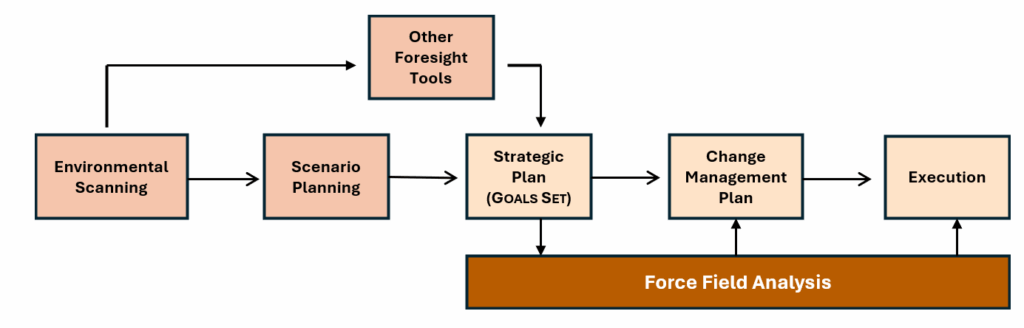
- It stimulates forward-looking conversations about what forces could influence success or failure in the future.
- FFA helps leaders anticipate barriers and enablers before implementing change.
- By visualizing forces that might help or hinder achievement of a longer-term goal or a strategic initiative, organizations can plan proactively rather than reactively.
In summary, Kurt Lewin has provided strategy professionals and leadership teams with a powerful and practical tool to facilitate success. For those strategy consultants and internal strategy professionals seeking a remote, professional development experience, exploring how AI can play a practical role in strengthening change and goal-achievement, our AI Strategy Lab offers a hands-on starting point. The Lab provides recorded training on twelve proven environmental assessment tools, paired with a companion AI prompt to help strategy professionals at once apply the tool in their own organizations.