
I still remember the first time I led a “strategic planning process.” It was 1978, and I was a new executive director of a small Chicago nonprofit serving people with disabilities. My goal was simple but daunting: earn accreditation from the Commission on Accreditation of Rehabilitation Agencies, which required a board-approved Comprehensive Long-Range Plan.
I had no idea how to do it. Resources were scarce, and both the board and staff were inexperienced. My solution? Hire an affordable governance advisor who mentored me through the process. When the plan was finally approved, I was hooked. That early experience with SWOT Analysis and visioning sparked my lifelong fascination with strategy consulting frameworks which are the mental models and management systems that help turn vision into reality.
Early in my career, I learned that frameworks don’t replace human insight, they amplify it. A framework doesn’t create a strategy; people do. But frameworks help people think more clearly, communicate more effectively, and act with greater alignment. They offer two lasting benefits:
- Structure for thinking – Breaking big, ambiguous challenges into manageable pieces.
- A shared language – Enabling leaders, managers, and teams to discuss strategy in common terms.
Used well, frameworks transform meetings from opinion battles into collaborative problem-solving sessions. They don’t guarantee success, but they improve your odds of achieving it. If you’re new to strategy, start with the classics. They remain timeless because they make the invisible visible.
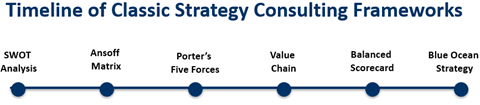
SWOT Analysis
The gateway to strategic thinking is the organization’s Strengths, Weaknesses, Opportunities, and Threats (Humphrey, 1960s). Use SWOT Analysis (or OTSW Evaluation)[1] early in the process to organize what you know about the organization’s internal and external environment. A common pitfall is to treat the results as a static list rather than a conversation that leads to priorities. https://hbr.org/2021/02/are-you-doing-the-swot-analysis-backwards?utm_source=chatgpt.com
The Ansoff Matrix
Igor Ansoff’s (1965 ) product/market grid maps growth options: Market Penetration, Market Development, Product Development, and Diversification. It is used to explore growth paths and associated risks. A major value is the exploration of trade-offs between options, and the capabilities that need to be successful. https://link.springer.com/chapter/10.1007/978-1-349-13877-7_24?utm_source=chatgpt.com
Porter’s Five Forces
Introduced by Michael Porter (1979), this model explains the competitive forces shaping your industry. Use it to assess market structure and profitability. It is important to focus not only on competition, but also on how the organization can shape competitive forces impacting the organization. https://www.isc.hbs.edu/strategy/business-strategy/Pages/the-five-forces.aspx?utm_source=chatgpt.com
The Value Chain
Another Michael Porter (1985) innovation is the Value Chain. It reveals how value is created across your organization’s activities. It is quite helpful in pinpointing the organization’s true sources of advantage. A common pitfall is treating the value chain as static rather than a dynamic, evolving system. https://www.isc.hbs.edu/strategy/business-strategy/Pages/the-value-chain.aspx?utm_source=chatgpt.com
The Balanced Scorecard
Kaplan and Norton (1990s) redefined planning as strategic management by linking objectives, measures, and initiatives across four perspectives: Financial, Customer, Internal Process, and Learning & Growth. It makes a major contribution to aligning daily operations with strategic priorities. While it’s an important reporting tooling, it also forms a core element of an ongoing management system. https://www.hbs.edu/faculty/Pages/item.aspx?num=9161&utm_source=chatgpt.com
Blue Ocean Strategy
Developed by W. Chan Kim and Renée Mauborgne (2005), the Blue Ocean Strategy approach moves beyond competing in crowded “red oceans” toward creating new, uncontested “blue oceans” of market space. It is often used when organization’s are stuck focusing on incremental improvements or price competition. It facilitates value innovation grounded in data and customer insight. https://hbr.org/2004/10/blue-ocean-strategy?utm_source=chatgpt.com
In the late 1990s, I saw strategy evolve from producing a plan to building a system for continuous execution and adaptation. That shift became the foundation of the Strategic Management Performance System (SMPS) we teach and use in our consulting practice at LBL Strategies. It integrates these (and other) tools into a practical strategy formulation, execution, and performance management system committed to continuous process improvement.
If you’re beginning your strategy journey:
- Start small, go deep. Master one or two frameworks before adding more.
- Use them as conversation tools. The value lies in the dialogue, not the diagram.
- Adapt to your context. Modify models to fit your reality; don’t fall in love with them.
- Connect frameworks into a system. True strategy lives where strategy, planning, execution, and performance reinforce each other.
Nearly five decades after that first plan in 1978, I still use these frameworks, but now as part of a living, adaptive system. They remain the language of strategy consulting. When used correctly they become a shared language that turns ideas into action and plans into results. For every beginner entering the field: learn the frameworks, but more importantly, learn to think strategically.
[1] From our perspective, this tool is better identified as an “OTSW” Evaluation. We believe in most cases external opportunities and threats should be determined before internal strengths and weaknesses. A strategy should be fashioned based on the realities of the current and future market and customer needs, not the day-to-day operating needs of the organization itself. It certainly is the case that internal strengths and weaknesses can be strategic in nature, but in most cases, we believe that they should be identified after analyzing the external environment.