
Today’s leaders face a perfect storm of complexity including multi-layered organizations, limited resources, shifting priorities, and volatile environments that can change overnight. For many government agencies and large enterprises, leadership turnover, potential disruptions such as government shutdowns, and uncertainty surrounding budgets or directives from agencies like the Department of Government Efficiency (DoGE) make it increasingly difficult to sustain focus and momentum.
Yet these are precisely the conditions under which strong strategic management is most essential. Organizations that can set and sustain high-impact strategic objectives (those that directly influence mission outcomes and long-term value creation) stand apart. They do so not by predicting the future, but by preparing for several plausible ones.
Strategic foresight is no longer optional. It is the discipline that allows organizations to explore alternative futures by understanding how social, technological, economic, environmental, and political trends may converge to shape what’s next.
By incorporating foresight into strategy formulation, leaders can identify the key drivers of success that should shape their strategic objectives. These drivers often emerge from systematic environmental scanning and cross-functional dialogue. For example, a public sector agency might identify workforce agility, data transparency, and interagency collaboration as its primary strategic drivers.
Once those drivers are understood, high-impact strategic objectives should flow naturally from them. Without this alignment, even the most well-written objectives risk being aspirational slogans rather than catalysts for transformation.
Even the most thoughtful strategy fails without disciplined implementation. Many organizations find themselves trapped in a recurring cycle: a new plan is developed, enthusiasm peaks briefly, and then execution falters. Over time, this erodes credibility and reinforces a self-fulfilling prophecy that “strategy doesn’t work here.”
Why does this happen? Often, implementation is not embedded as an organizational strength. Teams may lack a shared rhythm for executing, monitoring, and learning from progress. As a result, individuals engage inconsistently, initiatives drift, and accountability becomes diffuse.
To counter this, strategic management must be viewed as a living system, not a static plan. Implementation becomes far more achievable when objectives are aligned to the specific processes that drive their accomplishment, e.g., budgeting, workforce development, technology investments, and operational improvement.
Creating a culture of execution requires rhythm. A strategic management calendar can serve as the backbone of that rhythm, i.e., a recurring set of activities, milestones, and reviews that integrate strategy into the daily life of the organization.
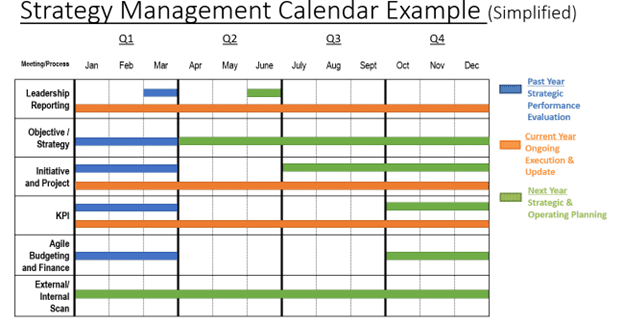
For instance, quarterly strategy review sessions, annual environmental scans, quarterly “Listening Posts,”[1] and annual scenario updates help sustain strategic alignment and adaptability. This rhythm reinforces focus, transparency, and continuous learning, ensuring that objectives evolve as conditions change.
The rhythm should also cascade across levels:
- Enterprise level: Define mission-critical outcomes and align resources.
- Division level: Translate strategic objectives into actionable performance objectives and measures.
- Team level: Track progress, celebrate wins, and identify needed adjustments.
When this cadence becomes part of the organization’s culture, strategy stops being an event and becomes a way of operating.
Developing the internal capacity to manage this process is increasingly recognized as a professional competency. Many leaders pursue strategy certification programs to strengthen their skills in strategic management, foresight, and performance integration. These programs equip professionals to move beyond traditional planning, toward a dynamic system of strategy formulation, execution, and continuous improvement.
Organizations that invest in certified strategists gain not just trained professionals, but also a shared language and framework for managing complexity. That shared discipline accelerates transformation and builds resilience, even when leadership turnover or external disruptions occur.
Creating high-impact strategic objectives is both art and science. It requires insight into what drives success, foresight into emerging challenges, and commitment to sustained implementation.
In environments marked by uncertainty and change, those organizations that align their objectives, processes, and people through a disciplined rhythm of strategic management will not just survive, they will thrive. Transformation begins not with more resources, but with clearer focus, stronger alignment, and an enduring cadence of execution.
[1] [1] A “Listening Post” is an individual or small team who actively monitor a single dimension of the external environment on a real time basis. It includes being accountable to the leadership team for reporting out on a quarterly basis regarding emerging weak signals, trends, and potentially disruptive changes on the horizon.